
What are tipping elements?
Tipping dynamics are triggered when a change in part of the Earth System (tipping system) becomes self-perpetuating beyond a critical threshold (tipping point), leading to substantial, widespread, often abrupt and/or irreversible physical, biophysical and/or biogeochemical impacts that in turn can induce far-reaching socioeconomic impacts. Sub-continental to continental-scale tipping systems are often referred to as tipping elements. Understanding the dynamics of tipping elements is crucial for developing effective strategies to mitigate and adapt to the impacts of global environmental change.
Why this project?
Tipping dynamics can lead to large and potentially irreversible impacts for human societies and the environment and pose a threat to the overall stability of the Earth system. Our current scientific knowledge of tipping elements involves a broad uncertainty on (1) whether certain components of the climate system and biosphere might actually show true tipping behavior, on (2) where the critical thresholds are located, (3) what Earth system feedbacks they are associated with, and (4) how potential tipping cascades might evolve. This uncertainty has numerous sources.
The most important are connected to:
- the representation of all necessary biophysical processes on the required timescales in Earth system models (in part, so far limited due to computational constraints),
- finding the “right” level of complexity or potential oversimplification of certain processes within and between Earth system components,
- the uncertainties related to the implementation of feedbacks associated with tipping elements in the models, and
- the limitations on observational data availability for long time horizons.
Aims of TIPMIP
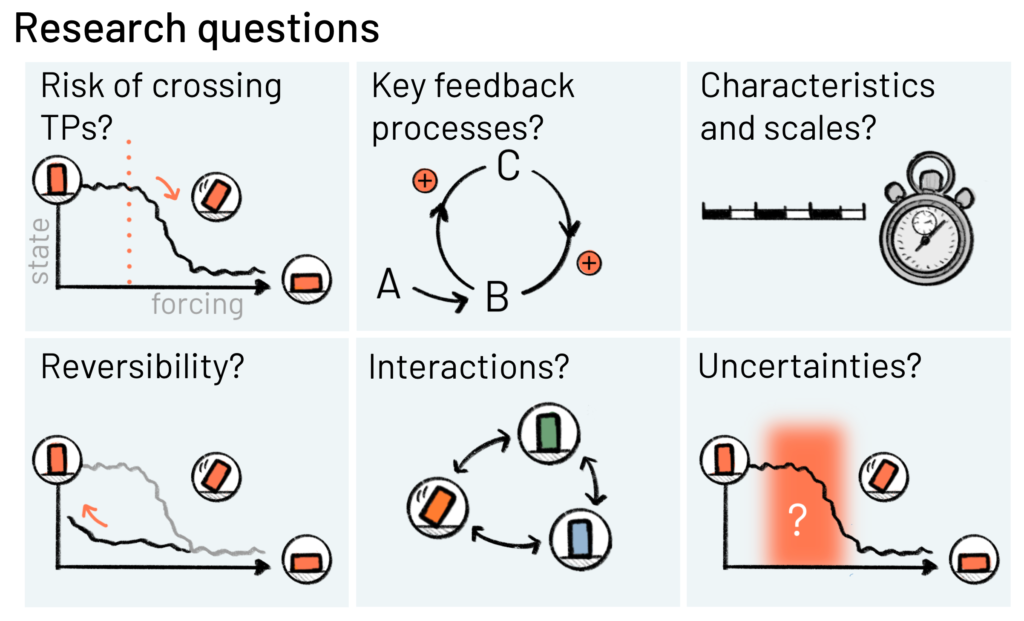
TIPMIP specifically aims at answering the following questions:
- What is the risk of crossing individual tipping points in the cryosphere, biosphere and core circulation systems at different levels of ongoing climate and land-use change?
- What are the key biophysical processes and feedbacks associated with tipping elements?
- What are the characteristics (spatial and time scales, abrupt or gradual, etc.) of the individual tipping elements?
- What are the respective changes reversible, and if so, on which timescales?
- Which are the most critical biophysical feedbacks involved in crossing different tipping points, and between elements affecting the overall stability of the Earth system?
- What are the quantitative uncertainties in our assessment of thresholds of tipping points corresponding to various tipping elements and the feedback strengths?
In addressing these questions, TIPMIP will fill critical knowledge gaps in Earth system and climate modelling by improving the assessment of overall Anthropogenic forcing and long-term commitments (irreversibilities). It will furthermore foster interdisciplinary knowledge transfer and shed light on critical processes currently underrepresented in Earth-system models and analysis. We will also address a range of more detailed science questions to make progress on process-level attribution, uncertainty, data requirements, and other related issues. Like other MIPs, we anticipate that TIPMIP would be initially designed to address a few research questions, and would involve a small number of experiments and models. The design of TIPMIP will evolve in the future to address additional science questions and include more experiments and models in successive versions.
Types of Experiments
Initially, we envision three major types of experiments for TIPMIP:
- A baseline experiment to analyze the historical and projected response of selected tipping elements to different climate and land-use change scenarios,
- A commitment experiment to assess the long-term consequences of surpassing different temperature and CO2 levels,
- A reversibility experiment to probe the reversibility of impacts and potential hysteresis behaviour.
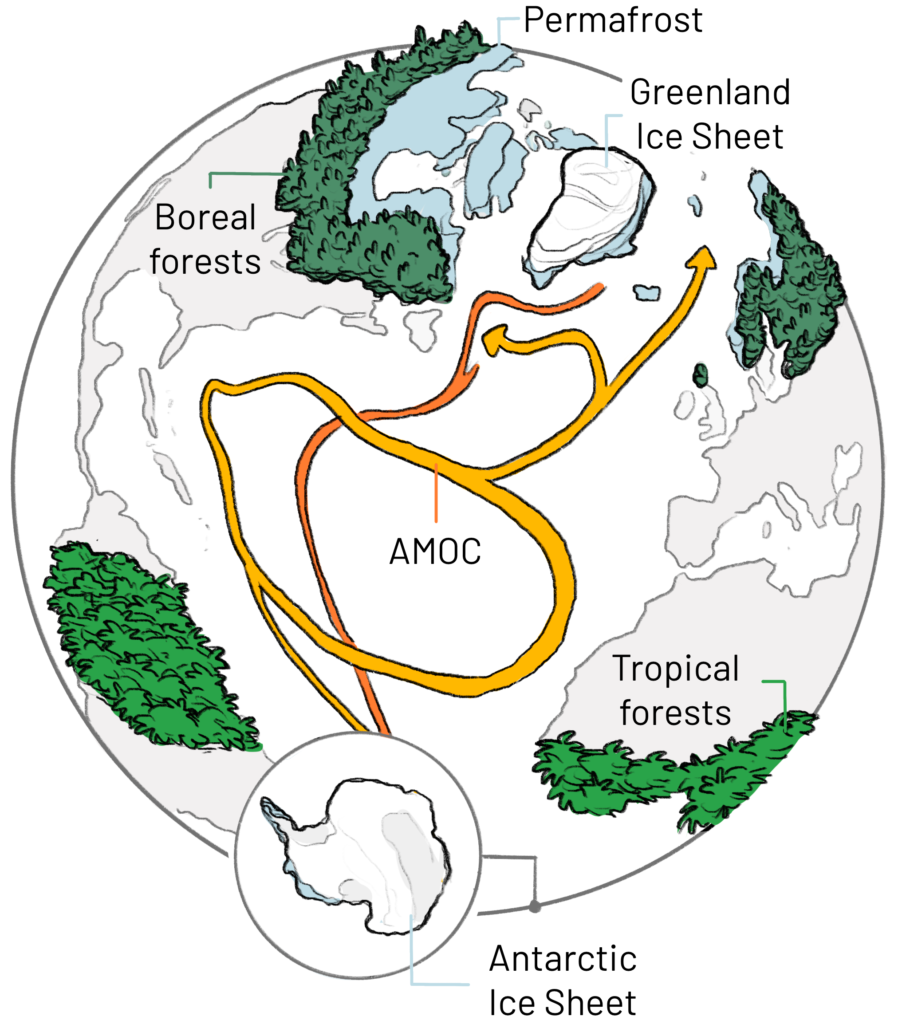
We propose to initially design these experiments for the assessment of key large scale tipping elements:
- Tropical rainforests
- Greenland Ice Sheet
- Antarctic Ice Sheet
- Atlantic Meridional Overturning Circulation (AMOC)
- Boreal forest
- Permafrost
For these systems, the mechanisms and feedbacks are relatively well-understood and there are already state-of-the-art models available that can simulate their tipping behaviour and potential impacts on the Earth system.
We invite ESMs and “stand-alone” models of different scales and research foci to join this new global effort to assess the potential threat of tipping elements in an innovative way. Successive versions of TIPMIP could be designed to estimate the climate and biogeochemical feedbacks associated with individual tipping elements and quantify the amplification of feedbacks in a cascade of tipping elements.