
TIPMIP-PERMAFROST uses stand-alone land surface models (LSM) and dedicated permafrost process models to conduct experiments and analyse key permafrost state variables, including soil temperature, soil water and ice contents, and soil organic carbon. A key focus is identifying permafrost processes that are relevant to Earth System tipping dynamics and characterizing their temporal and spatial scales across participating models. In addition, how permafrost may respond to climate extremes and potentially exhibit tipping behaviour will be explored through systematic modification of key hydrometeorological conditions.
Permafrost Domain Leads





Protocol
Protocol manuscript (draft expected end of September 2026)
Meanwhile check the following:
a technical guide for conducting experiments based on excerpt from manuscript;
EGU2026 abstract;
EGU2026 presentation.
Summary:
The experimental design across three tiers
- Tier 1 – Permafrost Response to Warming – Stabilization – Cooling (WZC) cycle: investigate the path dependency and reversibility of permafrost area, ground ice, and carbon content across the warming, stabilization, and cooling phases, and assess during the stabilization period whether the system exhibits any nonlinear responses.
- Tier 2 – Sensitivity of permafrost dynamics to extreme hydrometeorological forcing: assess how altered forcing regimes trigger or modulate tipping‑like responses.
- Tier 3 – Permafrost’s role in a tipping world: explore interactions between permafrost dynamics and other climate tipping elements (e.g., an AMOC collapse or a boreal‑forest shift).
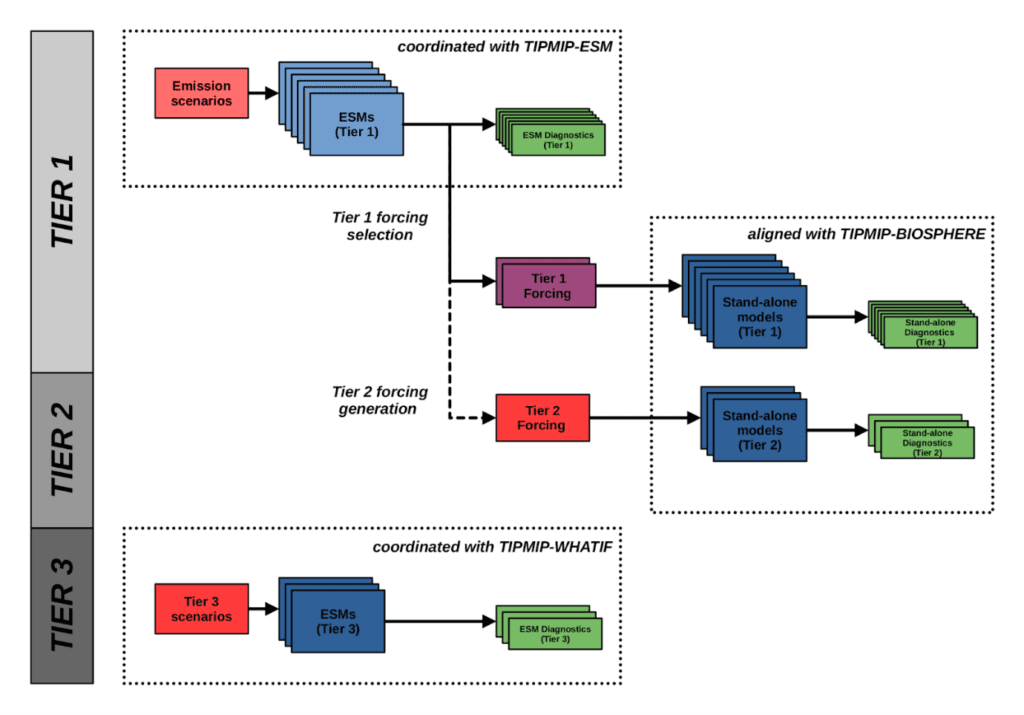
Figure 1: The three-tier TIPMIP experimental framework for stand-alone permafrost and land surface model experiments. Tier 1 forcing is taken from the TIPMIP‑ESM simulations consistently across TIPMIP domains. Tier 2 experiments will branch from Tier 1, with forcing designed to explore the sensitivity of permafrost state variables to changes in hydrometeorological extremes, in coordination with TIPMIP‑BIOSPHERE. Tier 3 experiments, coordinated with TIPMIP‑BIOSPHERE, TIPMIP‑WHATIF and TIPMIP‑OCEAN, will investigate interactions between permafrost and other climate tipping elements.
How to Contribute to TIPMIP-Permafrost?
To contribute to TIPMIP-Permafrost with your model, please follow these steps:
1. Check Participation Requirements
- Model output contributions: we anticipate contributions from LSMs (i.e., land components of ESMs and/or EMICs), preferably those registered in CMIP, although CMIP registration is not required, as the rules for registering standalone LSMs without a parent ESM remain unclear. Please also check the list (subject to updates) of expected LSM variables.
- Inclusion of diverse model types: we encourage contributions from all model types capable of conducting permafrost‑related process experiments, especially those not represented or misrepresented in LSMs, while ensuring fair comparison across model classes by providing at least some of the requested variables.
- Model documentation: to keep track of the available features across the model ensemble, modelling groups are requested to complete the model‑configuration form available here.
- Model setup and forcing: we do not prescribe model vertical structure, spatial or temporal resolution, initial conditions, or process configuration. Daily forcing data will be provided for the two mandatory TIPMIP‑ESMs (UKESM1‑2‑LL and MIROC‑ES2L) at their native time axes (e.g., 360_day, gregorian) and native spatial resolutions. Modelling groups are encouraged to use additional TIPMIP‑ESM forcings where resources allow. Please check the list of provided variables in Table 1 and get in touch if anything essential is missing for your simulations.
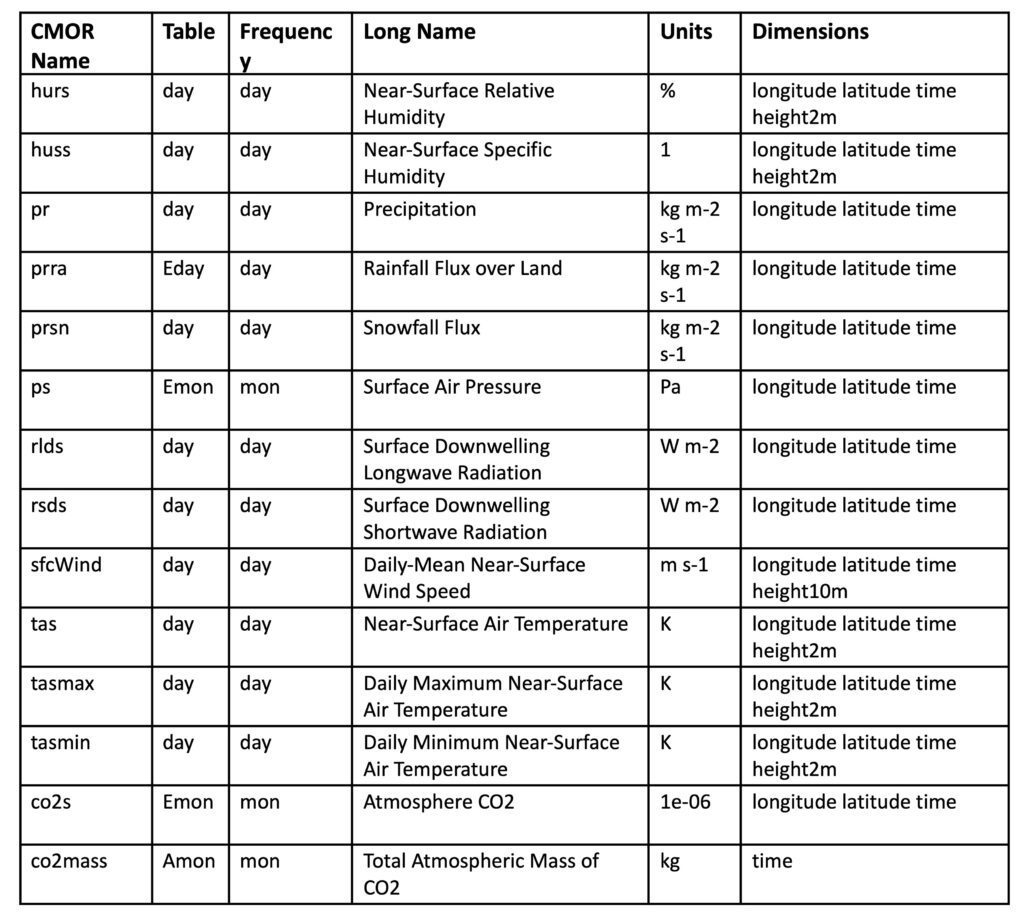
Table 1: List of prescribed climatic forcing variables serving as boundary conditions for all TIPMIP permafrost simulations. Variables are provided at daily temporal and the native resolution of the driving ESMs dataset and should be interpolated to the model grid where necessary.
2. Fulfill Data Submission Requirements
Participating groups are recommended to:
- Submit Tier 1 experiment requested variables for multi-model analysis papers by the 15.10.2026
- Plan for data publication: we intend to submit fully formatted data for publication. Our goal is to publish through the Earth System Grid Federation (ESGF), following CMOR recommendations, although the rules for submitting standalone models are not yet fully defined.
3. Formalize Your Participation
If you fulfill the requirements, contact the team to coordinate your model runs.
- Fill in the form under “Getting involved” > “Model Sign Up” pages.
- Please specify whether data sets used for initialization of your model (e.g., soil carbon, vegetation).
- Indicate which experiment the group is available to run.
- Send a copy of your sign-up to:
- The TIPMIP Central Coordination: tipmip@tipmip.org
- The Sectoral Coordinator: Goran Georgievski goran.georgievski@pik-potsdam.de
4. Next Steps
- Wait for feedback
- Contact Goran Georgievski (goran.georgievski@pik-potsdam.de) or Jose Licon-Salaiz (licon-salaiz@pik-potsdam.de) or Sina Loriani (sina.loriani@pik-potsdam.de) in Goran’s absence, to get access to forcing data and download them here
- Start the spin‑up, piControl, and all subsequent simulations
- To join discussions on future contributions and experiments, reach out to the contact points
How to Plan Your Analysis?
Follow these guidelines for conducting and publishing your analysis:
- Collaboration & Protocols: Contact contributing institutions and potential co-authors for the protocol paper if your analysis requires specialized diagnostics or additional forcing datasets.
- Citation and Terms of Use:
To use the data, please check the Terms of Use for TIPMIP data. To contribute, check the Terms of Use for TIPMIP data contribution. In summary:
- Cite all datasets used in your publications using their assigned DOIs.
- Credit TIPMIP by citing:
- The main TIPMIP framework paper.
- The specific experiment protocol for the Permafrost domain.
- Consider including as co-authors the leads related to the model’s contribution
Notify the TIPMIP team of any scientific article based on TIPMIP data before submission to ensure registration in the TIPMIP publication database.
Get in Contact & Stay Updated
TIPMIP Permafrost Mailing List: tipmip-permafrost-wg@listserv.dfn.de
General Inquiries: Email the management team management@tipmip.org
Sectoral Coordination: Goran Georgievski at permafrost@tipmip.org
Additional Information for Contributors
- Experiment Troubleshooting: If your experiments consistently fail, consider checking bathymetric adjustments and/or upgrading ocean time steps. Reach out to the team for further assistance.
- Stay in touch: Contributors should review the protocol paper and keep up to date through the mailing lists.
Want to contribute but facing resource limitations?
Be aware that TIPMIP provides on-demand data storage and publishes the data on ESGF! Get in touch as soon as possible if your group needs assistance with data storage. You can reach out to the data team at data@tipmip.org.