
TIPMIP-Ocean coordinates and analyses experiments with Earth System Models (ESMs) and Coupled Atmosphere-Ocean General Circulation Models (CGCMs) and Earth Model of Intermediate Complexity (EMICs). A key focus is on investigating the tipping dynamics of the Atlantic Meridional Overturning Circulation (AMOC) in different models. The experiments include Secondary Forcing experiments, with additional freshwater discharges related to Greenland ice-sheet melting, ranging from idealized freshwater hosing to more realistic paleoclimate-based scenarios.
Ocean Domain Leads


Protocol
Protocol preprint (Updated 8. April 2026)
Summary:
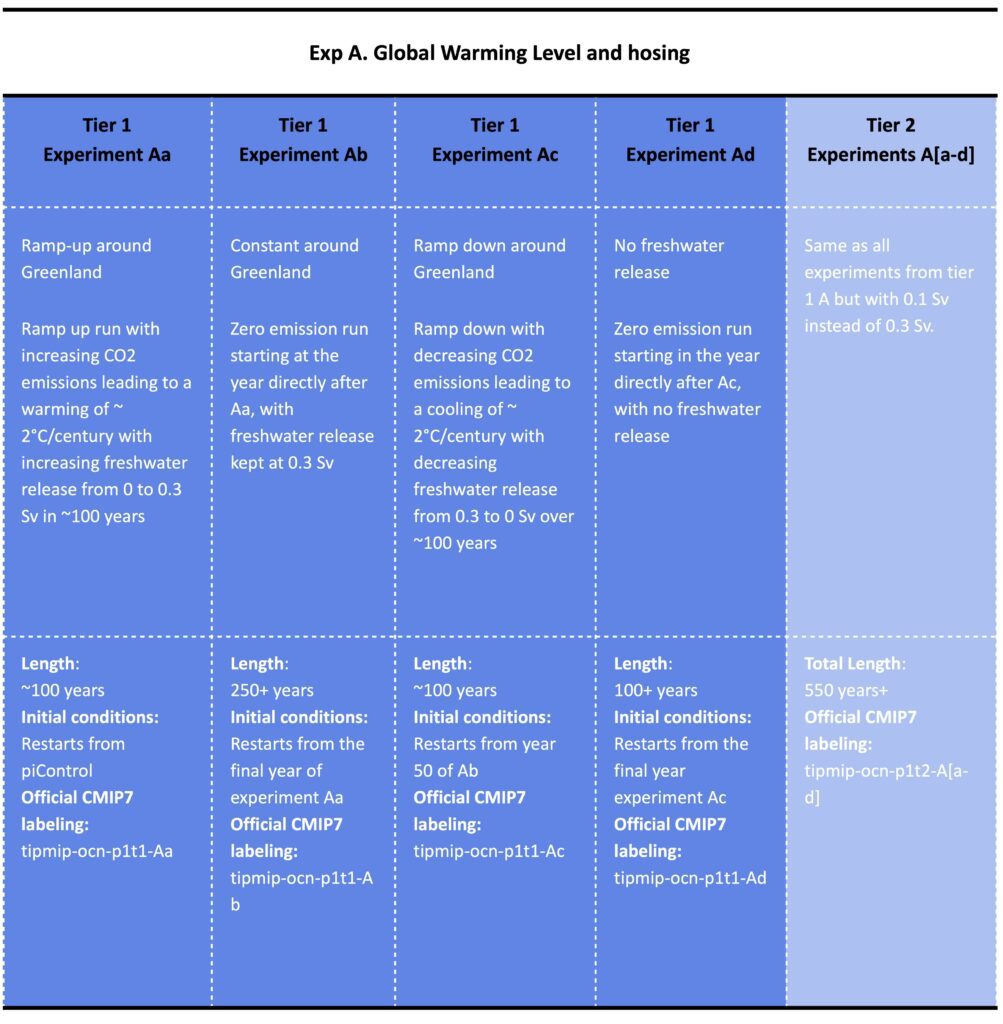
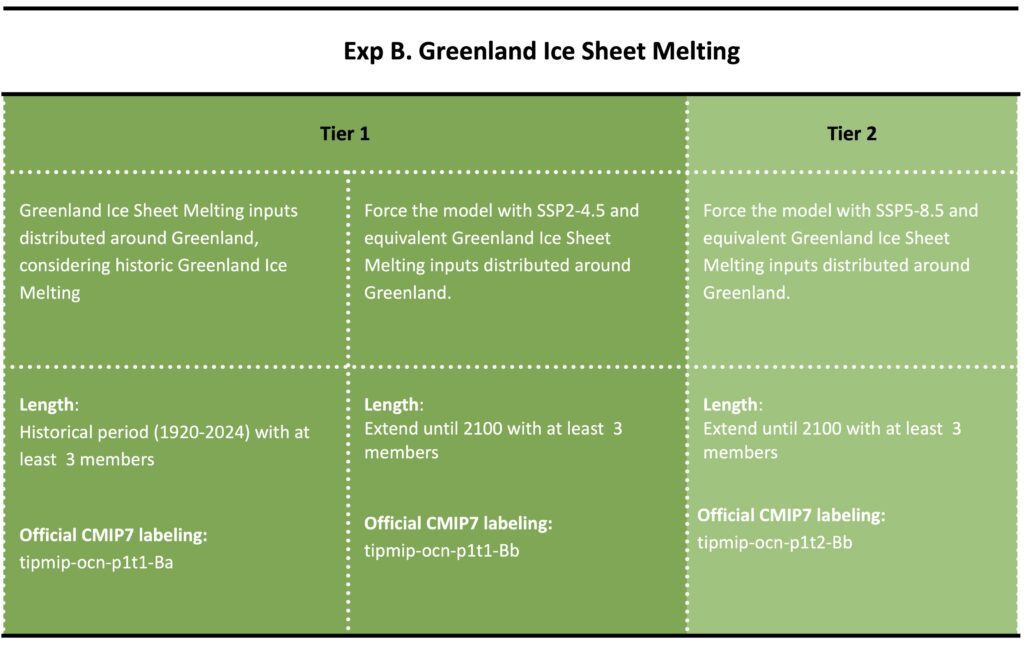
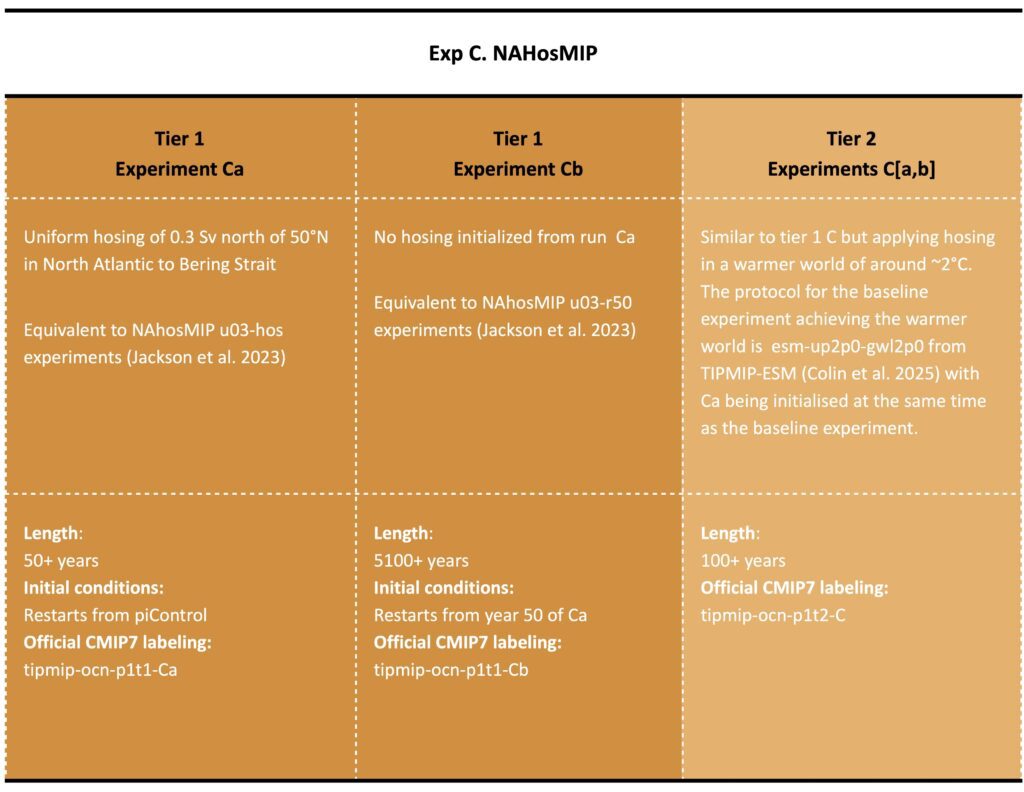
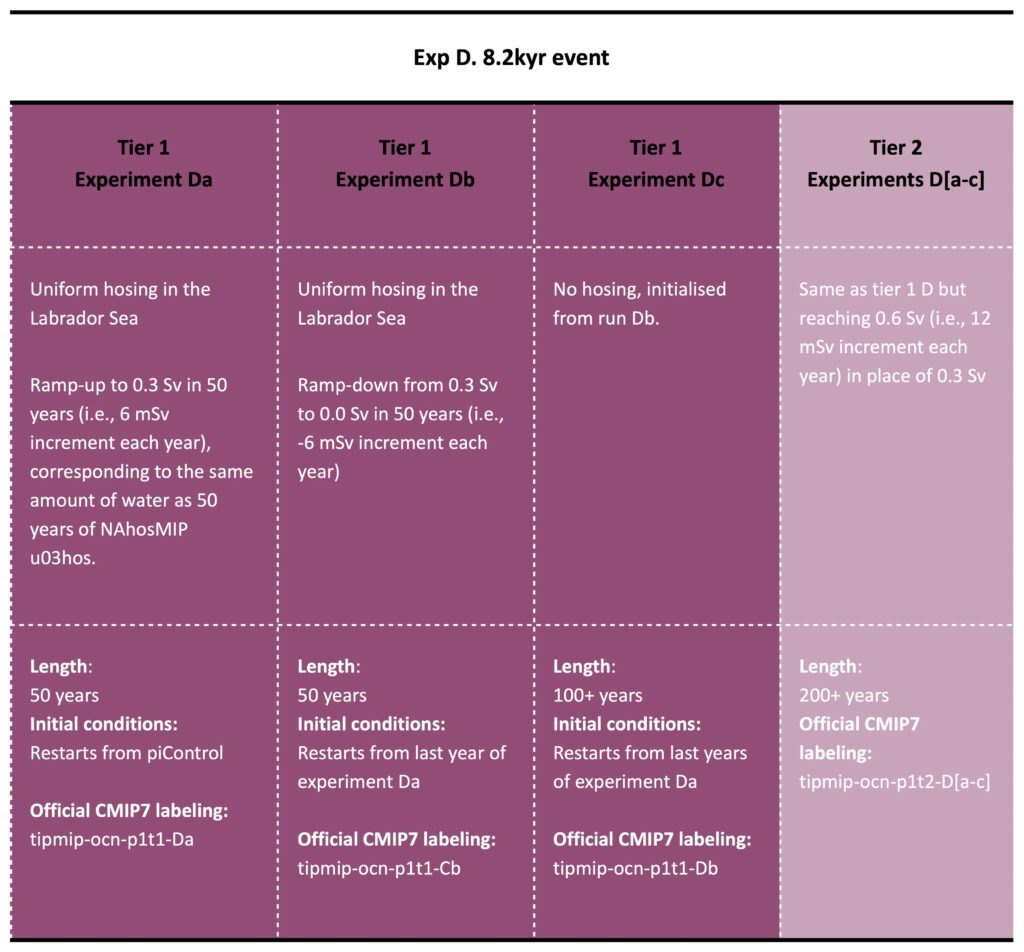
4 experiments with different hosing strategies
- Experiments A: examine AMOC reversibility in the presence of both increased global temperature and freshwater input around Greenland.
- Experiments B: examine how AMOC thresholds vary across models due to a larger amount of freshwater discharge.
- Experiments C: assess model responses to freshwater simulating a scenario from paleoclimate records.

Figure 1: Location of hosing (freshwater release) for different experiments. a) for hosing around Greenland in experiments A, exponentially reducing from the coastline (shown as values for 0.3 Sv hosing), b) uniform hosing for experiment C and c) Labrador Sea hosing for experiment D (shown as values for 0.6 Sv hosing). Values plotted are freshwater fluxes expressed in m/s.
How to Contribute to TIPMIP-Ocean?
To contribute to TIPMIP-Ocean with your model, please follow these steps:
1. Check Model Requirements
- For joining the ensemble, it is recommended to use physical models: ESMs, CGCMs, and/or EMICs, preferably registered in CMIP
- We encourage the experiments for all model types to perform within their capabilities, while recommending a fair comparison across model types.
2. Fulfill Data Submission Requirements
Participating groups are recommended to:
- Submit some data outputs for multi-model analysis papers by June 2026. Please follow the list of recommended variables list.
- Plan to submit fully formatted data to the Earth System Grid Federation (ESGF) by September 2026, following CMOR recommendations, preferably CMIP7.
3. Formalize Your Participation
If you fulfill the requirements, contact the team to coordinate your model runs.
- Fill in the form under “Getting involved” > “Model Sign Up” pages.
- Please specify whether your model includes biogeochemistry and/or an ice-sheet component.
- Indicate which experiment the group is available to run.
- Send a copy of your sign-up to:
- The TIPMIP Central Coordination: ocean@tipmip.org
- The Sectoral Coordinator: Nicole Laureanti nicole.laureanti@pik-potsdam.de
4. Next Steps
- Wait for feedback
- Start preparing the freshwater forcing files, with the defined locations for each experiment in Fig. 1
- Start runs
- To join discussions on future contributions and experiments, reach out to the contact points.
How to Plan Your Analysis?
Follow these guidelines for conducting and publishing your analysis:
- Collaboration & Protocols: Contact contributing institutions and potential co-authors for the protocol paper if your analysis requires specialized diagnostics or additional forcing datasets.
- Citation and Terms of Use:
To use the data, please check the Terms of Use for TIPMIP data. To contribute, check the Terms of Use for TIPMIP data contribution. In summary:
- Cite all datasets used in your publications using their assigned DOIs.
- Credit TIPMIP by citing:
- The main TIPMIP framework paper.
- The specific experiment protocol for the Ocean domain.
- Consider including as co-authors the leads related to the model’s contribution
- Notify the TIPMIP team of any scientific article based on TIPMIP data before submission to ensure registration in the TIPMIP publication database.
How to Get in Contact & Stay Updated
- Mailing List: Subscribe to the TIPMIP Ocean Listserv at tipmip-amoc-wg@listserv.dfn.de
- General Inquiries: Email the management team at team@tipmip.org
- Sectoral Coordination: Nicole Laureanti at ocean@tipmip.org
Additional Information for Contributors
- Experiment Troubleshooting: If your experiments consistently fail, consider checking bathymetric adjustments and/or upgrading ocean time steps. Reach out to the team for further assistance.
- Stay in touch: Contributors should review the protocol paper and keep up to date through the mailing lists.
Want to contribute but facing resource limitations?
Be aware that TIPMIP provides on-demand data storage and publishes the data on ESGF! Get in touch as soon as possible if your group needs assistance with data storage. You can reach out to the data team at data@tipmip.org.