
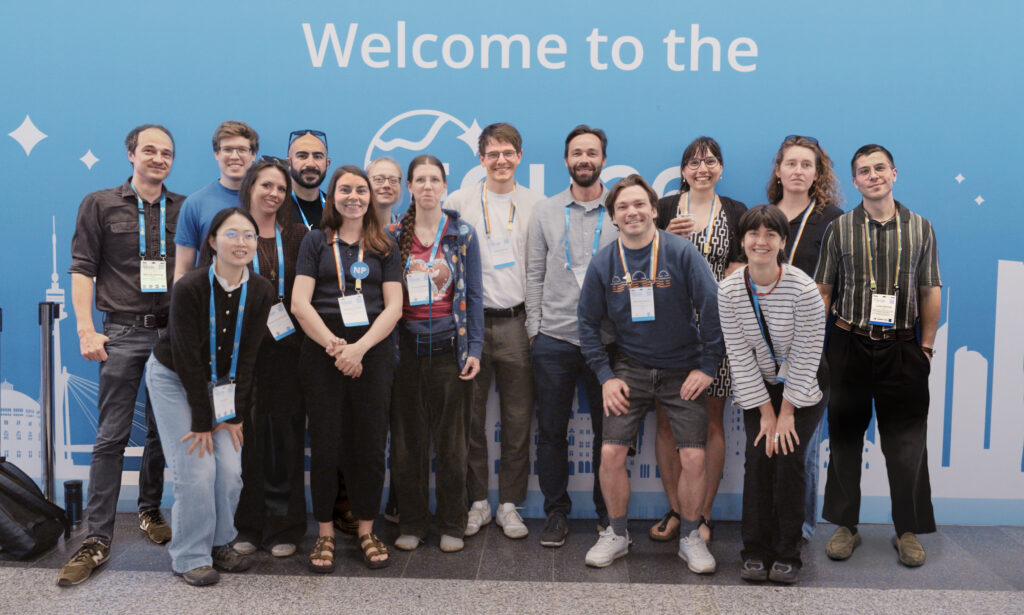
The Tipping Points Modelling Intercomparison Project was well represented at the EGU General Assembly 2026, held from 2–8 May in Vienna. Bringing together over 20,000 geoscientists from 125 countries, the annual meeting provided an important opportunity to share recent developments from across TIPMIP and exchange ideas with the wider Earth system research community.
A central meeting point was the TIPMIP splinter session, “Updates and Information from the Tipping Points Modelling Intercomparison Project (TIPMIP)”, organised by Donovan P. Dennis, Ann Kristin Klose, Goran Georgievski, Delphine Tardif and Ricarda Winkelmann. The meeting brought together existing and prospective TIPMIP contributors to discuss progress across the project, including first results from ongoing experiments, recently developed offline domain modelling protocols, new publications and preprints, and plans for 2026 and early 2027.
Several contributions presented ongoing work on individual tipping elements. Delphine Tardif presented “TIPMIP-BIO: Towards a unified simulation protocol to assess potential tipping behaviour in the biosphere and associated feedbacks and processes”, introducing efforts towards a common framework in the biosphere domain. Goran Georgievski presented the “Permafrost Experimental Protocol within the Tipping Point Modelling Intercomparison Project (TIPMIP)”, outlining the experimental framework developed to investigate permafrost responses across models.
The cryosphere was represented by a poster from Donovan P. Dennis and colleagues on “Investigating Greenland Ice Sheet tipping in the Tipping Points Modeling Intercomparison Project (TIPMIP)”. In addition, Ann Kristin Klose showcased joint work with Ricarda Winkelmann on “Future Antarctic ice loss under climate overshoot trajectories”, addressing the long-term response of the Antarctic Ice Sheet under temporary exceedance of climate targets. Shivani Ehrenfeucht contributed a poster on her investigation into Antarctic tipping and subglacial hydrology in “Basal environment uncertainty and the triggering of Antarctic Ice Sheet tipping points“.
Jakob Harteg further presented work he’s been developing with Sina Loriani and Jonathan Donges, in his presentation “Detecting Abrupt Shifts and Coherent Spatial Domains in Earth System Data with TOAD“.
Together, these contributions highlighted the breadth of work currently taking place within and around TIPMIP—from the biosphere and permafrost to the Greenland and Antarctic ice sheets—and the ongoing effort to establish coordinated modelling approaches for studying tipping processes across the Earth system.
For a glimpse behind the scenes of the wider Earth Resilience Science Unit (ERSU) community, of which TIPMIP is a part, at EGU26 – see the following video.